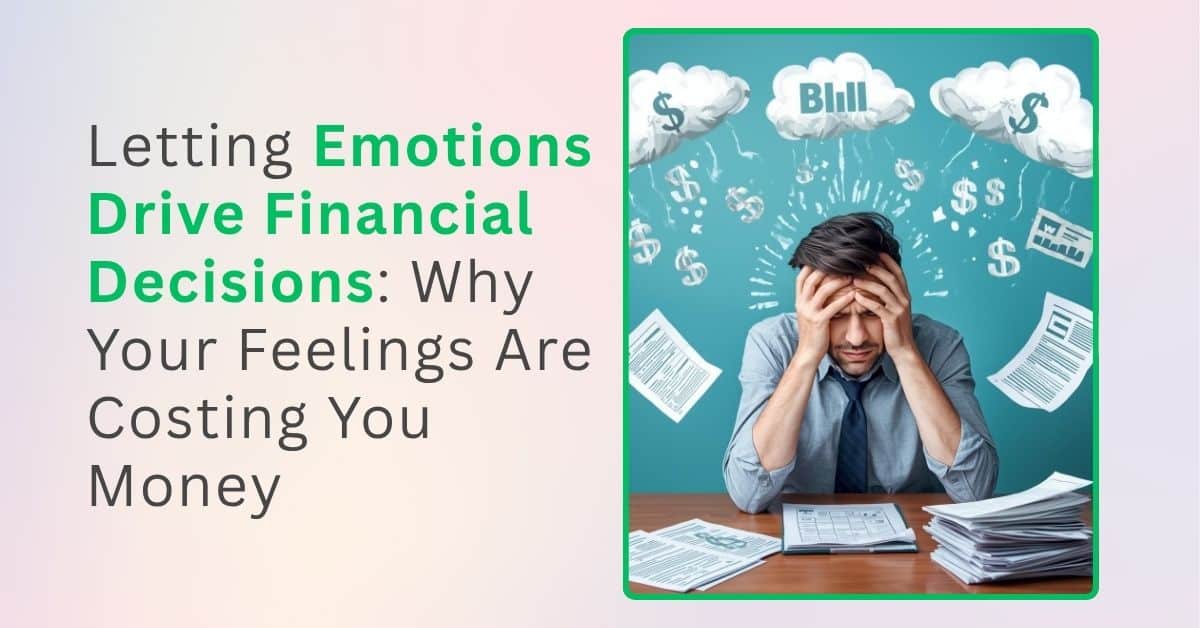
Letting Emotions Drive Financial Decisions: Why Your Feelings Are Costing You Money
Letting Emotions Drive Financial Decisions: The Silent Wealth Killer
Ask yourself honestly: when you check your investment account, do you feel anxious during market dips? Do you suddenly want to buy just because everyone on social media is buying? Do you hold onto losing stocks hoping they’ll bounce back? If yes, welcome to emotional investing—and it’s costing you real money.
In my experience, the gap between good investment ideas and financial success isn’t knowledge or strategy—it’s the emotional discipline to stick to your plan when the market tests your patience. Research shows investors could lose roughly 3% of returns annually due to emotionally driven decisions, and during high-stress periods like market crashes, this can jump to 6–7%. That’s wealth evaporating silently while you sleep.
Here’s the uncomfortable truth: letting emotions drive financial decisions is the most common reason wealth builders fail to build wealth. Yet the solution is simpler than you think.
How Emotions Hijack Your Financial Decisions
Our brains evolved to keep us safe from immediate threats—a lion in the savanna, a snake at our feet. But our modern financial system wasn’t built for ancient survival instincts. When markets drop 10%, your amygdala—the fear center of your brain—triggers the same panic response as seeing a predator. The result? You make decisions designed to survive the moment, not to build long-term wealth.
Let me show you how this actually works:
Fear Paralyzes You Into Bad Moves
Fear isn’t just an emotion—it’s a behavioral driver that distorts how you see risk. When markets fall, fear creates two destructive behaviors:
Panic selling during downturns: In 2020, when the pandemic crashed markets by 35%, millions of investors sold mutual funds and exited equity SIPs—exactly when buying would have been most profitable. They “locked in” losses at the worst possible time. Today, those same investors wish they’d stayed invested through the recovery.
Paralysis through inaction: Others, frozen by fear of making “the wrong choice,” never start investing at all. They watch inflation erode their purchasing power while their savings in fixed deposits earn 2–3% annually. Fear doesn’t just cost returns—it costs the power of compounding itself.
A loss aversion bias underlies both behaviors. Research shows the emotional pain of losing ₹10,000 is approximately twice as powerful as the joy of gaining ₹10,000. This imbalance in your brain causes you to hold onto losing investments far longer than rational analysis would suggest, hoping to recover losses that could have been allocated to better opportunities.
Greed Blinds You to Risk
On the flip side, greed makes you reckless. During bull markets, greed whispers: Everyone else is making money. This stock can’t stop. Why aren’t you all-in?
Imagine this: You hear about a hot new IPO everyone’s discussing. Without due diligence, you invest your emergency fund because “missing out” feels worse than the risk. Or during an IT stock boom, you dump most of your portfolio into tech, ignoring basic diversification rules. This isn’t investing—it’s gambling dressed up as strategy.
Overconfidence bias intensifies the problem. After a few winning trades, your brain convinces you that you’ve cracked the market. You believe you can predict trends better than professionals. Studies show this bias leads to excessive trading, concentrated portfolios, and an underestimation of losses. Each trade costs fees. Each overconcentration costs diversification benefits. Each overconfident decision costs long-term compounding.
Other Emotional Traps That Drain Your Wealth
Beyond fear and greed, three more emotional biases quietly sabotage your finances:
Confirmation bias: You seek news that supports your existing beliefs while ignoring contradictions. You bought a pharmaceutical stock because of one positive report and now ignore all warnings about clinical trial failures. Your brain filters reality to confirm what you already believe.
Herd mentality: During market booms, everyone rushes into the same assets. During corrections, everyone panics out together. The collective stampede creates bubbles and crashes. You participate not through analysis but through the fear of being left behind. In India, this played out vividly with the recent boom in certain IPO segments—investors piled in at inflated prices simply because “everyone was doing it.”
Recency bias: You assume recent trends will continue forever. Because tech stocks rose for three years, you believe they’ll rise forever—until they don’t. This bias causes you to buy high (when recent performance is impressive) and sell low (when recent performance has tanked).
The Real Cost: What Emotional Investing Steals From You
Numbers tell the story clearly. A 2022 study found that the average equity fund investor earned 10% less than the S&P 500 index—not because the market underperformed, but because individual investors’ emotional decisions underperformed the market.
Let me put this in perspective for Indian investors:
Scenario 1: The Panic Seller
- You invested ₹5 lakh in equity mutual funds starting in 2018
- During the 2020 pandemic crash, fear overtook you
- You sold everything at the bottom to avoid “further losses”
- Your portfolio would have crashed ~35% (₹3.25 lakh left)
- But within 18 months, markets recovered and went 40% higher
- Your emotional decision cost you approximately ₹2.5+ lakh in missed gains
Scenario 2: The Greedy Trader
- You started with ₹5 lakh in 2020
- Overconfident in your trading ability, you traded frequently (monthly)
- Average brokerage + taxes: 1–2% per trade
- You made 12 trades that year: ₹10,000–20,000 lost just to costs
- Even if trades broke even, you’d still lose 2–4% to emotional friction
- Over 5 years: ₹50,000–2 lakh in preventable costs
These aren’t rare stories. They’re the norm for emotionally driven investors.
How to Reclaim Control: Practical Strategies That Work
Understanding the problem is step one. Actually fixing it is what builds wealth. Here are strategies I recommend to overcome emotional investing:
1. Create a Written Investment Plan (Your Emotional Insurance Policy)
Before making a single investment, write down:
- Your goal: What are you saving for? Retirement in 25 years? A house in 5 years?
- Your risk tolerance: Can you stomach a 20% portfolio drop without panicking?
- Your timeline: When do you need this money?
- Your asset allocation: What percentage in stocks, bonds, real estate?
The act of writing transforms vague feelings into concrete rules. When fear strikes during a crash, you pull out your written plan and ask: Has my 25-year retirement goal changed? No. Has my risk tolerance changed? No. Then why should my strategy change?
A written plan is your emotional circuit-breaker. It stops you from reacting to short-term noise.
2. Automate Your Investments (Remove Yourself From the Decision)
Here’s a psychological hack: Automation removes emotion because there’s nothing to decide.
Set up a Systematic Investment Plan (SIP) that automatically deducts ₹10,000 (or any amount) from your salary every month and invests it in your chosen fund. You don’t wake up one day and decide to invest—it happens without you.
This has two superpowers:
You buy during crashes: When markets fall 20%, your SIP continues buying. Your ₹10,000 now buys more units. This is the power of rupee-cost averaging—you’re guaranteed to buy some units at low prices.
You don’t chase returns: Because you’re already invested passively, you don’t feel the urge to jump into hot trends. You’re not trying to time the market because your plan doesn’t require it.
Data shows SIP investors dramatically outperform lump-sum investors who try to time entries, especially during volatile periods.
3. Use Stop-Losses and Take-Profit Rules (Let Discipline Replace Emotion)
Before buying any individual stock, decide in advance: If this stock falls 15%, I sell. If it rises 30%, I book profits and redeploy.
These predetermined exit rules sound restrictive but they’re actually liberating. They remove the emotional question “Should I sell?” and replace it with a mechanical answer: The rule says sell, so I sell.
Many investors resist this because of loss aversion—admitting a loss feels painful even if it’s rational. But discipline feels less painful than watching a 50% portfolio crash because you hoped for a recovery that never came.
4. Review Your Portfolio Periodically, Not Constantly
Here’s a behavioral insight: The more frequently you check your portfolio, the more likely you are to panic.
If you check your equity portfolio daily, you’ll see 100+ days per year where it’s “down.” Even a diversified portfolio drops 5–10% several times per year. But if you check quarterly, you see the actual trend beneath the noise.
I recommend:
- Equity portfolios: Review quarterly or semi-annually
- Full portfolio: Review annually
- Never check daily unless you’re an active trader
Reducing monitoring frequency rewires your brain away from short-term anxiety toward long-term perspective.
5. Keep a Behavioral Journal (Awareness Beats Impulse)
This sounds simple, but it’s transformative: Write down your emotional state whenever you make a financial decision.
When you feel an urge to buy or sell, note:
- What triggered this? (News? Social media? Market movement?)
- What emotion am I feeling? (Fear? Greed? FOMO?)
- What’s my actual plan say I should do?
Review these notes quarterly. Patterns emerge—I always panic-sell during monsoon season, I always FOMO-buy after my friends make gains—and patterns become predictable, manageable.
Awareness is the first defense against emotional mistakes.
6. Diversify Your Portfolio (Spread Risk, Spread Stress)
A diversified portfolio feels less volatile than a concentrated one. If your entire wealth is in one IT stock, a 10% move feels catastrophic. If it’s spread across stocks, bonds, real estate, and international assets, a 10% move is a minor fluctuation.
Diversification isn’t just risk management—it’s emotional management. It reduces the stress and urgency you feel during downturns, which means you’re less likely to make panicked decisions.
7. Focus on Process, Not Results
This is subtle but critical: Judge yourself on whether you followed your plan, not on whether you made money.
Ask yourself: Did I stick to my SIP? Did I rebalance as planned? Did I panic-sell against my strategy?
Don’t ask: Did the market cooperate with my wishes?
You control process. You don’t control markets. When you judge yourself on process, you become resilient because you know you did everything right even if markets temporarily misbehaved.
Real-World Example: Two Investors, One Emotional Choice
Meet Priya and Anita. Both started in 2018 with ₹10 lakh.
Priya made an investment plan, invested in a diversified SIP, and ignored market noise. During the 2020 crash, her portfolio fell to ₹6.5 lakh. She felt afraid but stuck to her plan. By 2024, her portfolio was ₹18 lakh. She turned ₹10 lakh into ₹18 lakh through discipline and time.
Anita invested aggressively in hot stocks, tried to time the market, and watched social media obsessively. During the 2020 crash, she panicked and sold everything at ₹6.5 lakh—locking in a loss. She reinvested cautiously in “safe” bonds earning 4%. By 2024, her original ₹10 lakh became ₹11.8 lakh through defensive choices and fear.
Both faced the same market. One emotion cost Anita ₹6+ lakh in opportunity.
The Bottom Line: Emotion or Wealth—You Can’t Have Both
Here’s what I’ve learned from personal finance and investment psychology: Wealth isn’t built by people who are smarter than the market. It’s built by people who are disciplined about their decisions.
The gap between your financial dreams and financial reality isn’t knowledge—it’s emotional discipline. It’s the ability to stay calm when everyone around you is panicking. It’s the courage to keep investing when headlines scream “crash.” It’s the restraint to ignore trends that don’t fit your plan.
Emotions will always exist. Fear, greed, hope, regret—they’re part of being human. But here’s the good news: You don’t need to eliminate emotions. You just need to systematize your decisions so emotions can’t hijack them.
Write a plan. Automate your investments. Set rules. Review periodically. Keep a journal. Diversify your assets. Focus on process, not results.
Do this, and your feelings will take a backseat to your financial goals.
Your next step? Start today. Open a document. Write your financial goals, your risk tolerance, and your investment rules. Print it and post it near your workspace. When emotion strikes—and it will—read that document before making any move.
Rational decisions compound. Emotional decisions crater. Choose wisely.