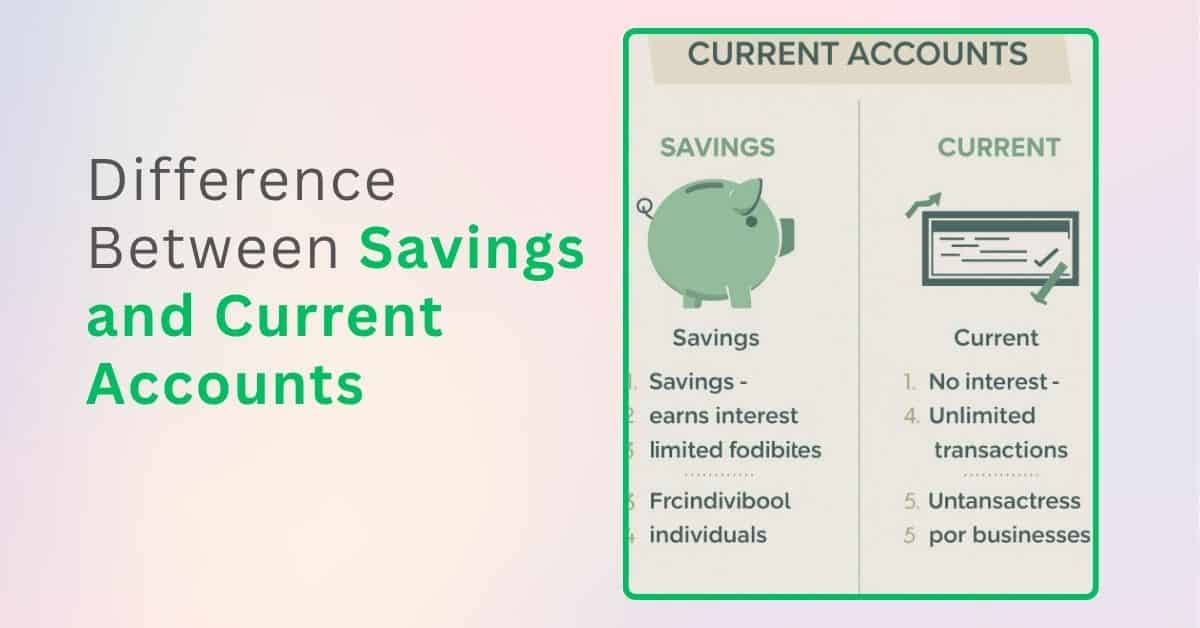
Difference Between Savings and Current Accounts: A Practical Guide to Choosing the Right Account
Imagine walking into a bank and being asked: “Would you like a savings account or a current account?” If that question left you confused, you’re not alone. In my experience working with countless individuals managing their finances, this is one of the most overlooked decisions that can actually impact your banking costs and convenience significantly.
The truth? The difference between savings and current accounts goes far beyond just the name. These accounts are designed for entirely different financial goals—and choosing the wrong one could cost you money in hidden charges, limit your transaction freedom, or even prevent you from earning that interest you deserve.
Let me show you exactly how these accounts work, their key differences, and most importantly, which one is right for your situation.
What Is a Savings Account?
A savings account is a basic banking product designed to help individuals save money safely while earning interest on their balance. It’s the most common account type for salaried professionals, students, retirees, and anyone looking to build an emergency fund.
Key Features of Savings Accounts:
- Interest Earnings: You earn interest on your balance (typically 2–7% per annum, depending on the bank and current market rates)
- Withdrawal Limits: Monthly withdrawal limits (usually 3–5 free withdrawals; additional withdrawals may incur charges)
- Minimum Balance: Ranges from ₹0 to ₹10,000 (varies by bank and account type)
- Monthly Transactions: Limited transactions (usually 3–5 free deposits and withdrawals combined)
- Cheque Facilities: Limited or no cheque books provided
- Overdraft: Typically not available
- Account Maintenance: Minimal fees; some banks charge if balance falls below minimum
“A savings account is like a piggy bank with a salary—it helps you grow your money safely, but with reasonable transaction limits.”
Who Should Open a Savings Account?
- Salaried employees receiving monthly income
- Students managing pocket money or scholarship funds
- Retirees living on pensions or fixed income
- Anyone building an emergency fund
- Investors keeping idle cash for short-term opportunities
What Is a Current Account?
A current account is a business-focused banking product designed for high-volume financial transactions. It’s built for entrepreneurs, businesses, traders, and organizations that need frequent deposits and withdrawals without worrying about transaction limits.
Key Features of Current Accounts:
- No Interest: You earn zero interest on your balance (the trade-off for unlimited transactions)
- Unlimited Transactions: Unlimited deposits and withdrawals with no monthly limits
- Minimum Balance: Much higher than savings accounts (typically ₹25,000–₹1,00,000+)
- Cheque Facilities: Multiple cheque books issued free of cost
- Standing Instructions: Easy setup for recurring payments and automatic transfers
- Overdraft Facility: Many banks offer overdraft credit lines for eligible customers
- Account Maintenance: Higher monthly or annual charges (₹500–₹2,000+ depending on the bank)
- Banking Services: Access to advanced services like payroll processing, bulk payments, and reconciliation tools
Who Should Open a Current Account?
- Business owners and entrepreneurs
- Traders and wholesale merchants
- Non-profit organizations and NGOs
- Companies and partnerships
- Freelancers with high transaction volumes
- Anyone conducting frequent B2B transactions
Savings vs Current Account: Head-to-Head Comparison
| Feature | Savings Account | Current Account |
|---|---|---|
| Primary Purpose | Personal savings & income management | Business & high-volume transactions |
| Interest Rate | 2–7% per annum | 0% (no interest) |
| Monthly Transactions | 3–5 free (limited) | Unlimited |
| Minimum Balance | ₹0–₹10,000 | ₹25,000–₹1,00,000+ |
| Monthly Charges | ₹0–₹200 (usually free) | ₹500–₹2,000+ |
| Cheque Facility | Limited or none | Unlimited |
| Overdraft | Rarely available | Commonly available |
| Withdrawal Limit | Limited per month | No limit |
| Ideal For | Individuals, employees, students | Businesses, traders, organizations |
| Account Opening | Simple & quick | Requires documentation & verification |
Interest Earnings: The Real Cost of Choosing Wrong
Here’s where the difference between savings and current accounts becomes financial reality for you.
Imagine you’re a small business owner with ₹5 lakh in your bank account. If you opened a savings account instead of a current account:
- Annual Interest Earned: ₹5,00,000 × 5% = ₹25,000 per year
- But with a current account: ₹0
On the flip side, if you’re earning ₹1 lakh monthly and opened a current account:
- Monthly Charges: ₹1,500 × 12 = ₹18,000 per year
- Plus zero interest: You’re losing money instead of earning it
This is why choosing correctly matters. Let me show you how to decide.
How to Choose: Savings vs Current Account for Your Needs
Choose a Savings Account if:
✓ You receive a regular salary or fixed income
✓ You need to save money for emergencies or future goals
✓ Your monthly transactions are fewer than 10
✓ You want to earn interest on idle money
✓ You’re an individual (not a business owner)
✓ You prefer minimal account fees and charges
Practical Example: Priya earns ₹50,000 monthly as a software engineer. She receives her salary in her savings account and withdraws money for household expenses. She makes about 3–4 transactions per month. A savings account is perfect for her needs and earns her ₹1,500–₹2,000 annually in interest.
Choose a Current Account if:
✓ You run a business or are self-employed
✓ You make frequent deposits and withdrawals (50+ per month)
✓ You receive multiple client payments or make supplier payments
✓ You need overdraft facilities for working capital
✓ You need bulk payment capabilities
✓ You conduct B2B transactions regularly
Practical Example: Ravi runs a textile import business and processes 200+ transactions monthly—vendor payments, customer receipts, bill payments. A current account with unlimited transactions, cheque facility, and overdraft support is essential. The ₹1,000 monthly charge is justified by the convenience and business needs.
Understanding Minimum Balance Requirements
One of the most overlooked aspects of the difference between savings and current accounts is the minimum balance trap.
Savings Account Minimum Balance:
- ₹0–₹5,000: Basic tier accounts from most banks
- ₹5,000–₹10,000: Standard savings accounts
- Penalty: ₹100–₹500 per month if balance falls below minimum
Current Account Minimum Balance:
- ₹25,000–₹50,000: Small business tiers
- ₹1,00,000–₹5,00,000+: Premium business accounts
- Penalty: ₹1,000–₹3,000+ per month if balance falls below minimum
Pro Tip: Always maintain a buffer of 10–15% above your minimum balance requirement. This prevents accidental penalties and gives you transaction flexibility.
Transaction Limits: What You Need to Know
Savings Account Limitations:
The Reserve Bank of India (RBI) sets guidelines for savings account transactions. Most banks allow:
- 3–5 free deposits per month
- 3–5 free withdrawals per month
- Excess transactions charged at ₹20–₹50 per transaction
Current Account Freedom:
Current accounts offer unlimited deposits and withdrawals at no extra charge. This is the primary advantage for businesses handling high-volume transactions.
Real Scenario: If you’re a freelancer earning ₹2–3 lakh monthly with clients across 5–10 different payment sources, even one extra withdrawal would cost you ₹50–₹100. Multiply that by 12 months, and you’re losing ₹600–₹1,200 annually. A current account might save you money despite higher charges.
Dormant Accounts: Rules You Must Know
The difference between savings and current accounts extends to dormancy rules too.
- Savings Account: Becomes dormant if no transaction occurs for 24 months
- Current Account: Also becomes dormant after 24 months of inactivity
What Happens?
- Your account gets frozen
- You can’t withdraw money without reactivating it
- Reactivation usually requires a visit to the bank with original documents
Frequently Asked Questions
Can I Use a Savings Account for Business?
Technically, yes—but it’s not recommended. Banks may freeze your account if they detect business activities. Most banks ask you to convert to a current account or face account closure.
What’s the Difference in Online Banking?
Both accounts offer similar online banking features (transfers, bill payments, mobile banking). Current accounts may offer additional features like bulk payments, but core functionality is similar.
Can I Have Both Accounts?
Absolutely. Many business owners maintain a savings account for personal income and a current account for business operations. This separation also helps with accounting and tax filing.
Which Account Earns More Interest?
Savings accounts earn interest (2–7% annually). Current accounts earn zero interest. This is the fundamental trade-off.
Best Practices: Making the Most of Your Account
For Savings Account Holders:
- Choose a high-yield savings account if available from your bank
- Keep minimum balance buffer to avoid penalties
- Set up automated transfers to a fixed deposit for better returns
- Track your monthly transactions to avoid excess charges
For Current Account Holders:
- Negotiate fees with your bank (larger transaction volumes often get discounts)
- Maintain optimal minimum balance (not too much idle money)
- Use overdraft facilities strategically, not as permanent credit
- Reconcile accounts weekly to catch discrepancies early
The Bottom Line: Savings vs Current Account
The difference between savings and current accounts isn’t just academic—it’s financial. Here’s what you need to remember:
A savings account is your personal money manager—safe, interest-earning, and perfect for earning income and managing expenses. A current account is your business powerhouse—unlimited transactions, but at a cost and without interest.
The choice is straightforward: If you’re an individual managing personal finances, a savings account is right for you. If you run a business or need 50+ transactions monthly, a current account makes financial sense.
In my experience, most people get this wrong. They either waste money on unnecessary current account charges or lose money in transaction fees with a savings account when they should’ve upgraded to a current account.
Here’s what you should do right now:
- Assess your monthly transaction volume
- Calculate the cost of excess transaction charges on a savings account
- Compare with current account fees at your preferred bank
- Whichever option costs less is the right choice for you
The difference? It could save you ₹5,000–₹15,000 annually. That’s money in your pocket.